BlogBeaches
Greek Beach Law Explained: Sunbeds, Free Space and the MyCoast App
What Law 5092/2024 really says about sunbeds and free sand, why the famous 70% rule is a myth, the 251 no-sunbed beaches and how to use MyCoast.
Contents · 8
The short version
Every beach in Greece is public. Businesses can rent part of one from the state, but they cannot take all of it, cannot block your way to the water, and cannot charge you for sitting on the free sand. The rules come from Law 5092/2024, and the government now gives visitors a way to help enforce them: the MyCoast app, where you can report a beach that breaks the rules.
The details matter, because they are often misquoted — including by the beach bars themselves. Here is what the law actually says, what it does not, and what you can do about it.
What the law says
The key rules for beach concessions under Law 5092/2024, in plain language:
- A concession can cover at most 50% of a beach. The rest stays open to the public.
- Sunbeds and umbrellas can occupy at most 60% of the concession area itself — and only 30% on protected beaches.
- A free strip of 4 metres along the water's edge must be left clear, so that anyone can walk along the shore and reach the sea.
- Free access to the beach must not be blocked. Fences, locked gates, rows of sunbeds across a path or staff turning people away all count.
- Fines for blocking free access range from €2,000 to €60,000 (figures checked September 2026).
In practice, that means on a typical organised beach you should find a significant stretch of open sand, a clear line along the water, and an unobstructed way down from the road.
The "70% free" myth
You will often read that "70% of every Greek beach must be free". It is a catchy shorthand that has circulated widely in the media, and it is not what the law says. The real limits are the ones above: concessions on no more than half of the beach, and sunbeds on no more than 60% of the concession (30% on protected beaches), plus the 4-metre strip. If you are going to argue your case with a beach manager — or file a report — quote the actual rules, not the shorthand.
251 beaches with no sunbeds at all
For 2026, the Environment Ministry lists 251 beaches where sunbeds and umbrellas are banned completely. These are designated untouched beaches, chosen for their natural value, where no concession of that kind is allowed. On them, you bring your own shade and take everything home again. The list is published by the ministry and can change from year to year, so check it before you count on a particular beach being empty — or, for that matter, on finding a sunbed there.
Plenty of other beaches are simply undeveloped, especially on the smaller islands and along the wilder coasts of places like Sithonia in Halkidiki or western Lefkada. Our Lefkada beaches by car and Halkidiki peninsulas compared guides mark which is which.
MyCoast: the app that gives the rules teeth
MyCoast is the Greek government's app for reporting beach violations. It is aimed at the public, not only at inspectors: if you find sunbeds right at the water's edge, a fenced-off beach or staff telling you to leave the free sand, you can file a report from your phone.
It is being used. Between mid-May and 17 August 2025, the app received 11,512 complaints. Halkidiki, near Thessaloniki, generated the most, with more than 2,400 — no surprise to anyone who has tried to find space on Kavourotrypes or around Sani in August.
How to make a useful report:
- Stay calm and do not argue on the beach. You are not there to enforce the law yourself; the app exists so that you do not have to.
- Take clear photos that show the problem in context — the sunbeds at the waterline, the blocked path, the fence.
- Note where you are as precisely as possible: the beach name, the business name if visible and your location.
- Describe what happened in a sentence or two: for example, that you were told you could not sit on the sand without renting a sunbed.
- Submit from the beach if you can, while the details are fresh.
A report can prompt an inspection; it does not mean an instant fine, and you will not necessarily hear back. Still, thousands of reports a season give the authorities a clear map of where to look.
What counts as a problem — and what does not
Probably reportable:
- Sunbeds or umbrellas placed inside the 4-metre strip along the water.
- A beach where the whole front is covered in sunbeds, with no free sand at all.
- Fences, ropes, gates or rows of furniture blocking the way to the sea.
- Staff insisting that you rent a sunbed or buy something to use the open, free part of the beach.
Not a violation:
- Prices. Sunbed sets can be very expensive, especially on the Athens Riviera, Mykonos and other fashionable coasts, but high prices are not illegal.
- Minimum spends on the rented sunbeds themselves. If you sit on a business's sunbed, its terms apply.
- A crowded free section. The law guarantees free space, not empty space.
What this looks like on a real beach
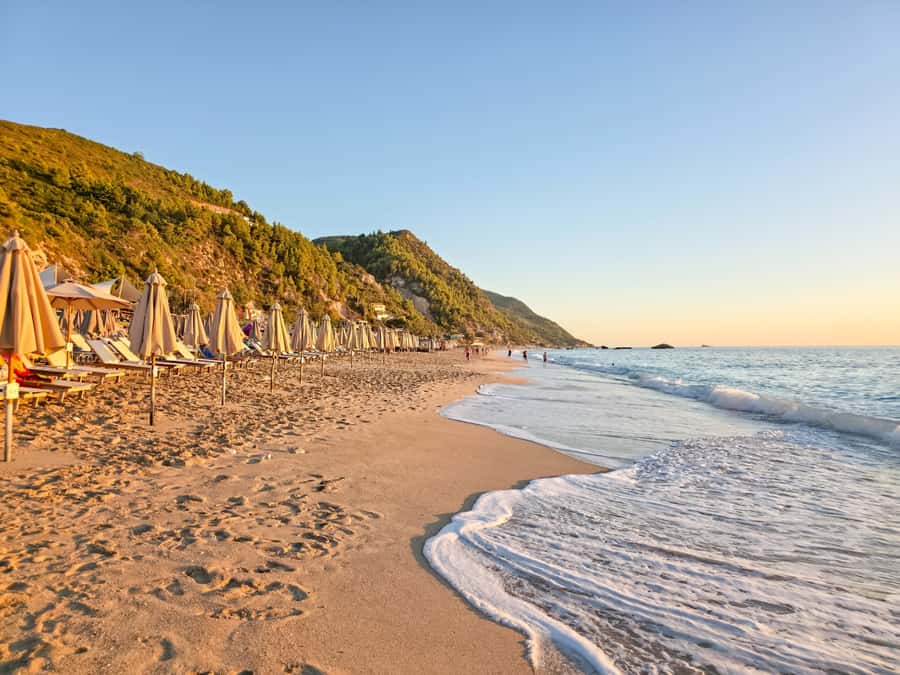
Take Kathisma on Lefkada, one of the most organised beaches on the Ionian: long, busy, lined with beach bars. Under the rules, it should still offer a clear walkway along the water, open sand between or beyond the concessions, and a way down from the car park that does not force you through a bar. The same goes for the famous organised beaches of Mykonos, the Athens Riviera and Kassandra.
If what you see is wall-to-wall sunbeds, that is precisely the situation MyCoast was built for. If instead you find a crowded but open stretch of sand, the law is working — it just is not glamorous.
Practical tips for a better beach day
- Bring your own umbrella. It is cheap, legal and makes the free sections usable in July and August. Many supermarkets on the islands sell them.
- Arrive early. On famous beaches such as Porto Katsiki or Psarou, the best free spots go by mid-morning.
- Respect protected beaches. On turtle nesting beaches in Zakynthos and elsewhere, extra rules limit where you can put an umbrella and when the beach is open — see our Zakynthos guide.
- Take your rubbish home, including cigarette butts.
- Check for lifeguards. On busier, organised beaches lifeguards are typically on duty in summer during the day, but many beaches have none — swim within your limits, especially on exposed coasts.
For more on costs, see our prices in Greece page, and for other rule changes this year read Greece travel changes in 2026. Planning your beach days by island? Start with our island finder or the best beaches in Crete.
Prices, fees and rules in this piece were checked in September 2026. They change — confirm with the operator or site before you travel.
Where to stay nearby
Live prices and availability on a map centred on this exact spot — hotels, studios and villas — so you can judge the distance to the beach, the port or the village from here rather than guess from an address.
Bookings made through this map earn us a commission. Your price is unaffected.
A travel advisor who writes about Greece the way he advises on it: island by island, with the catch attached to every recommendation. More about the author →
Frequently asked
Is it true that 70% of every Greek beach must be free?
No. That figure is media shorthand, not law. Under Law 5092/2024 a concession can cover at most 50% of a beach, sunbeds can occupy at most 60% of the concession (30% on protected beaches), and a 4-metre strip along the water must stay free.
Can a beach bar make me rent a sunbed to sit on the beach?
Not on the free part of the beach. Access must not be blocked and the open sand and the 4-metre strip along the water are for everyone. If staff insist, you can report it through the MyCoast app.
What is the MyCoast app?
The Greek government's app for reporting beach violations such as sunbeds at the waterline or blocked access. It received 11,512 complaints between mid-May and 17 August 2025, the most from Halkidiki.
What are the fines for blocking access to a beach?
Fines for blocking free access range from €2,000 to €60,000 (checked September 2026). A report can prompt an inspection, but it does not mean an instant fine.
Are there beaches in Greece where sunbeds are banned?
Yes. For 2026 the Environment Ministry lists 251 untouched beaches where sunbeds and umbrellas are banned completely. The list can change each year, so check it before you go.
Are high sunbed prices illegal?
No. Prices are set by the businesses and can be very high on fashionable coasts. What the law protects is free space and free access, not the cost of renting a sunbed.
Partner links · GetYourGuide
Tours, boat trips & tickets
Boat trips, guided tours of the ancient sites and tickets bookable ahead — free cancellation on most.
See all options: Greece beach boat trip →We may earn a commission from these. It never changes your price.
Before you go
We may earn a commission from these. It never changes your price.
Blog