About GreeceHistory
A Short History of Greece, Told Through the Places You Can Visit
From the Minoan palaces to the modern republic in one read: the periods that shaped Greece, and where to see each one with your own eyes.
Contents · 8
The short version
Greek history is long enough to be intimidating, but for a traveller it falls into a handful of chapters, each of which left something you can still walk through.
- Bronze Age (c. 3000–1100 BC): Cycladic, Minoan and Mycenaean cultures. See Knossos, Akrotiri, Mycenae.
- Archaic and Classical Greece (c. 800–323 BC): city-states, Delphi and Olympia, democratic Athens, the Parthenon.
- Hellenistic and Roman Greece (323 BC – 4th century AD): Alexander's successors, then Roman rule.
- Byzantium (4th–15th centuries): Orthodox Christianity, Thessaloniki, Mystras, Meteora.
- Venetians, Knights and Ottomans (13th–19th centuries): fortresses on the islands, Ottoman rule on the mainland.
- Modern Greece (1821 onwards): independence, expansion, war, dictatorship and democracy.
The Bronze Age: islands first
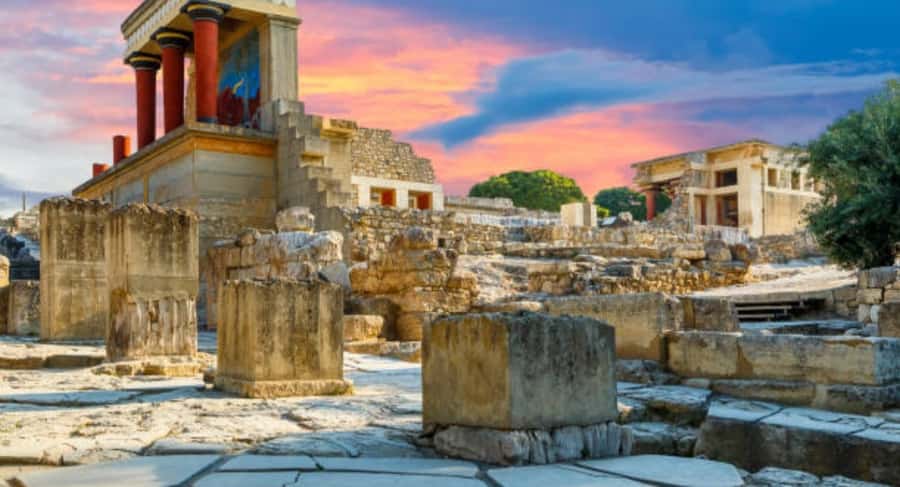
The first great civilisations in the Greek world were island ones. In the Cyclades, in the third millennium BC, people carved the flat marble figures that look startlingly modern today. On Crete, from around 2000 BC, the Minoans built palaces — complexes of courtyards, storerooms, workshops and painted halls — with no defensive walls to speak of, which says a great deal about their power at sea.
The most famous is Knossos, near Heraklion. In July 2025 it was inscribed on the UNESCO World Heritage list together with other Minoan palatial centres such as Phaistos and Malia. On Santorini, a colossal volcanic eruption in the Bronze Age buried the town of Akrotiri under ash, preserving multi-storey houses and wall paintings in a way that has earned it comparisons with Pompeii.
On the mainland, the Mycenaeans rose to power in the second millennium BC. They built fortified citadels with walls so massive that later Greeks believed giants had raised them. Mycenae, with its Lion Gate, is the one to see. The Mycenaeans wrote an early form of Greek in the script known as Linear B, and their world became the setting for Homer's epics about the Trojan War.
Around 1100 BC this world collapsed, for reasons still debated, and Greece entered a long period with few written records.
Archaic and Classical Greece: the city-states
From about the eighth century BC, Greece re-emerged as a patchwork of independent city-states — Athens, Sparta, Corinth, Thebes and hundreds of smaller ones — sharing a language, gods and a sense of being Greek, while constantly fighting each other. They founded colonies from the Black Sea to southern Italy. Tradition dates the first Olympic Games to 776 BC.
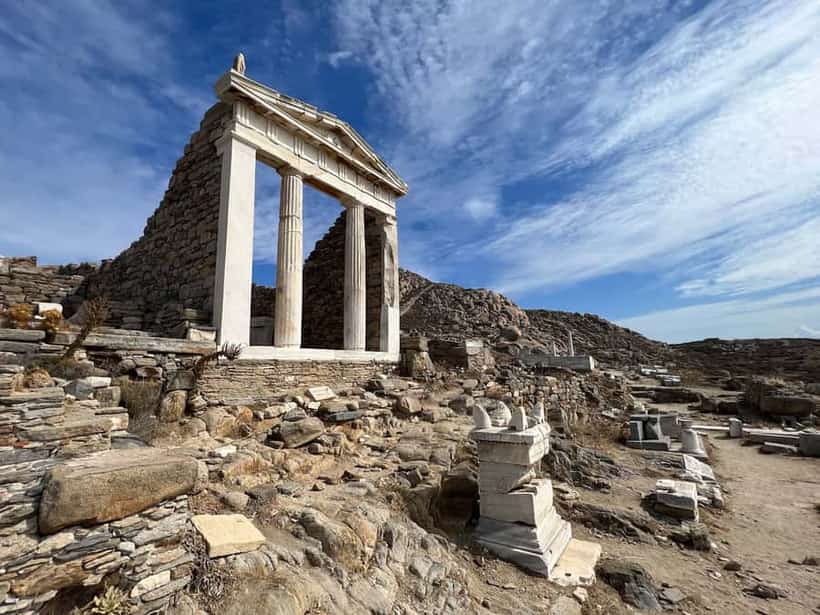
Shared sanctuaries held this world together. Delphi, the seat of Apollo's oracle, was consulted by cities and kings before every major decision. Olympia hosted the games in honour of Zeus. The small island of Delos, birthplace of Apollo and Artemis in myth, was a religious and later commercial hub for the whole Aegean.
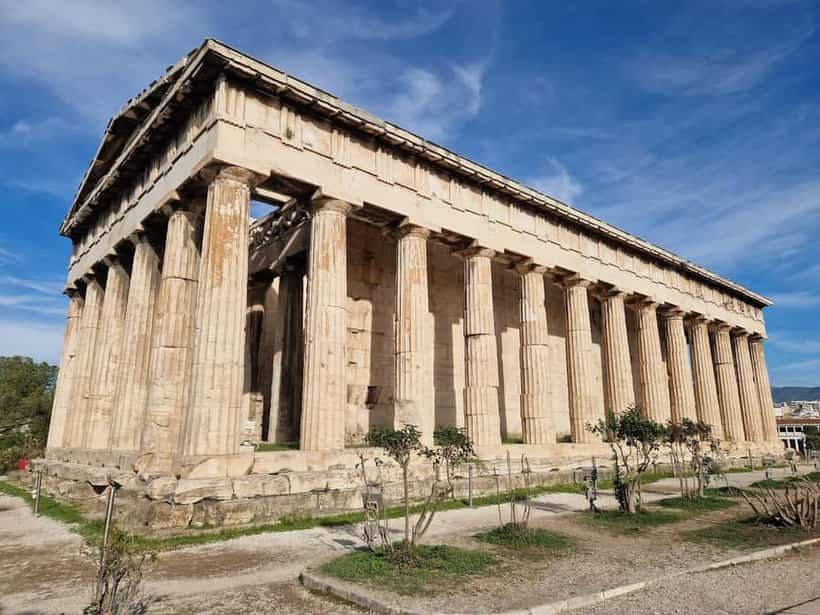
In the fifth century BC, the Greek cities defeated two Persian invasions, at Marathon in 490 BC and at Salamis in 480 BC. What followed in Athens is the period most people picture when they think of ancient Greece: the democracy, the theatre of Aeschylus, Sophocles and Euripides, Socrates arguing in the Ancient Agora, and the building programme of Pericles that produced the Parthenon on the Acropolis.
That golden age ended in the long Peloponnesian War between Athens and Sparta, which Athens lost in 404 BC. Our Acropolis tickets guide explains how to visit its greatest monument today.
Macedon, Alexander and Rome
In the fourth century BC, power shifted north to the kingdom of Macedon. Philip II brought the southern cities under his control, and his son Alexander the Great carried Greek language and culture as far as Egypt and India before his death in 323 BC. The royal tombs at Vergina, ancient Aigai, are among the most moving sites in northern Greece.
The Hellenistic kingdoms that followed were rich and cosmopolitan. Rhodes grew into a major naval and trading power and raised the Colossus, one of the Seven Wonders of the ancient world. Rome absorbed Greece step by step; the destruction of Corinth in 146 BC is the usual marker. Under Roman rule, Athens remained a university town for the empire's elite, and emperors from Hadrian onwards left their mark on it.
Byzantium: the Greek-speaking empire
When Constantine founded Constantinople in the fourth century AD, the eastern half of the Roman Empire gradually became a Greek-speaking, Orthodox Christian state that we now call Byzantium. It lasted more than a thousand years.
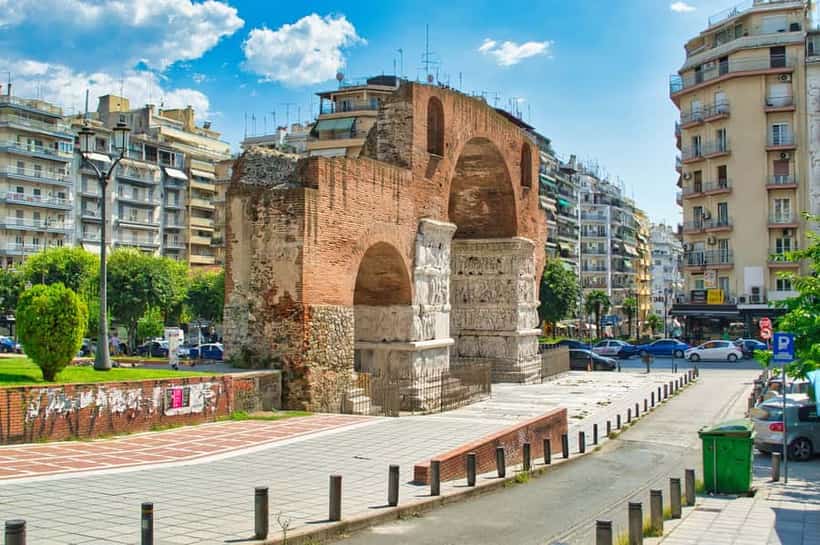
For travellers, this chapter lives in the churches. Thessaloniki, the empire's second city, preserves early Christian and Byzantine monuments such as the Rotunda. The late Byzantine city of Mystras in the Peloponnese survives almost whole on its hillside. And from the fourteenth century, monks built the monasteries on the rock pillars of Meteora. Orthodox faith, the Greek language and the memory of Byzantium would carry Greek identity through the centuries that followed.
Venetians, Knights and Ottomans
In 1204 the Fourth Crusade sacked Constantinople, and the Greek world was carved up. Venice took ports and islands — Crete, Corfu, much of the Cyclades, strongholds in the Peloponnese — and left behind harbours, fortresses and lion-of-St-Mark reliefs. The Knights of St John ruled Rhodes from the early fourteenth century until 1522 and built the walled city you see today, the Medieval City of Rhodes.
The Ottoman Turks took Constantinople in 1453 and, over the following two centuries, almost all of Greece. Crete fell in the seventeenth century after a long siege of Heraklion. Corfu and the Ionian Islands were the great exception: they never came under lasting Ottoman rule, which is why Corfu Town feels so Italian. Ottoman Greece left mosques, fountains, baths and a shared culinary vocabulary.
Independence and the making of modern Greece
The War of Independence began in 1821; Greeks still celebrate its start on 25 March. It was a hard, brutal war, finally decided when Britain, France and Russia intervened. The new kingdom's first capital was Nafplio, under the Venetian walls of Palamidi, before Athens took over in the 1830s.
The first Greek state was small. Over the next century it grew in stages: the Ionian Islands in 1864, Thessaly in 1881, and Crete, Macedonia and Thessaloniki after the Balkan Wars of 1912–1913. The Dodecanese, including Rhodes, joined only after the Second World War.
The twentieth century was turbulent. Defeat in Asia Minor in 1922 was followed by a population exchange with Turkey that brought well over a million refugees to Greece. On 28 October 1940 Greece refused an Italian ultimatum — the "Ochi" (No) still marked as a national holiday — and then endured a harsh German occupation and a civil war that lasted until 1949. A military junta ruled from 1967 to 1974; the student uprising at the Athens Polytechnic on 17 November 1973 is commemorated every year. Democracy returned in 1974, Greece joined the European Community in 1981 and adopted the euro in 2001.
How to use this history on the ground
- Short on time? In Athens you can walk from the Bronze Age to Byzantium in a day: Acropolis, Agora, Roman monuments, Byzantine churches in Plaka.
- On Crete, pair Knossos with a Venetian harbour town like Chania.
- In the Peloponnese, follow the story from Mycenae to Mystras to Nafplio.
For the full list of protected sites, read our guide to UNESCO sites in Greece; for the myths behind them, Greek mythology on the islands; and for tickets and practicalities, ancient sites in Greece.
Where to stay nearby
Live prices and availability on a map centred on this exact spot — hotels, studios and villas — so you can judge the distance to the beach, the port or the village from here rather than guess from an address.
Bookings made through this map earn us a commission. Your price is unaffected.
A travel advisor who writes about Greece the way he advises on it: island by island, with the catch attached to every recommendation. More about the author →
Frequently asked
What are the main periods of Greek history?
Broadly: the Bronze Age (Cycladic, Minoan, Mycenaean), Archaic and Classical Greece, the Hellenistic and Roman periods, Byzantium, Venetian and Ottoman rule, and modern Greece from the War of Independence in 1821.
Where can I see Minoan civilisation?
On Crete, above all at Knossos near Heraklion, which was inscribed on the UNESCO World Heritage list in July 2025 together with other Minoan palatial centres such as Phaistos and Malia. Akrotiri on Santorini shows a Bronze Age town buried by a volcanic eruption.
When did Greece become independent?
The War of Independence began in 1821, and Greeks celebrate its start on 25 March. The first capital of the new state was Nafplio, before Athens took over in the 1830s.
Why does Corfu feel so different from the rest of Greece?
Corfu and the other Ionian Islands were ruled by Venice for centuries and never came under lasting Ottoman rule, so their towns, architecture and food show a strong Italian influence.
What is Ochi Day?
A national holiday on 28 October marking Greece's refusal of the Italian ultimatum in 1940, which brought the country into the Second World War.
Before you go
We may earn a commission from these. It never changes your price.
About Greece