BlogWeather
The Meltemi Explained: Greece's Summer Wind and What It Means for Your Trip
What the meltemi is, when and where it blows, why ferries get cancelled, which beaches stay sheltered and where windsurfers go looking for it.
Contents · 9
The short version
- What: the meltemi is a dry, strong wind from the north that blows across the Aegean in summer.
- When: typically from mid-May to mid-September, peaking in July and August. Official wind data for Naxos show the Cyclades are windiest from July to October.
- Where: hardest in the Cyclades — Mykonos, Tinos, Andros, Naxos, Paros, Ios and their neighbours — and across the open Aegean. The Ionian islands and the Saronic Gulf feel it far less.
- Daily rhythm: usually calmer in the morning, strongest in the afternoon, easing towards night. It can also blow for several days without a break.
- What it does: cools the islands, blows sand across north-facing beaches, cancels high-speed ferries and, on the worst days, stops all sailings.
- What to do: leave buffer days in any island-hopping plan, pick beaches on the sheltered side, and never schedule your last ferry for the day of your flight home.
What the meltemi actually is
The meltemi (meltem in Turkish, which shares the name) is a seasonal wind. In summer, high pressure sits over the Balkans and low pressure over Turkey and the eastern Mediterranean; the air flows between them, funnelled south through the Aegean. In the northern Aegean it blows from the north-east, in the Cyclades mostly from the north, and around Crete and the Dodecanese it swings towards the north-west.
It is not a storm. Skies usually stay clear and blue, which is exactly what surprises visitors: a perfect-looking day with white horses on the sea, flags standing straight out and a harbour full of ferries that are not leaving. It is also the reason the Cyclades feel more bearable in July than Athens does. The same wind that makes the crossing rough keeps the islands' temperatures in check — the long-term average high on Naxos in August is around 27°C, against about 32°C in Athens.
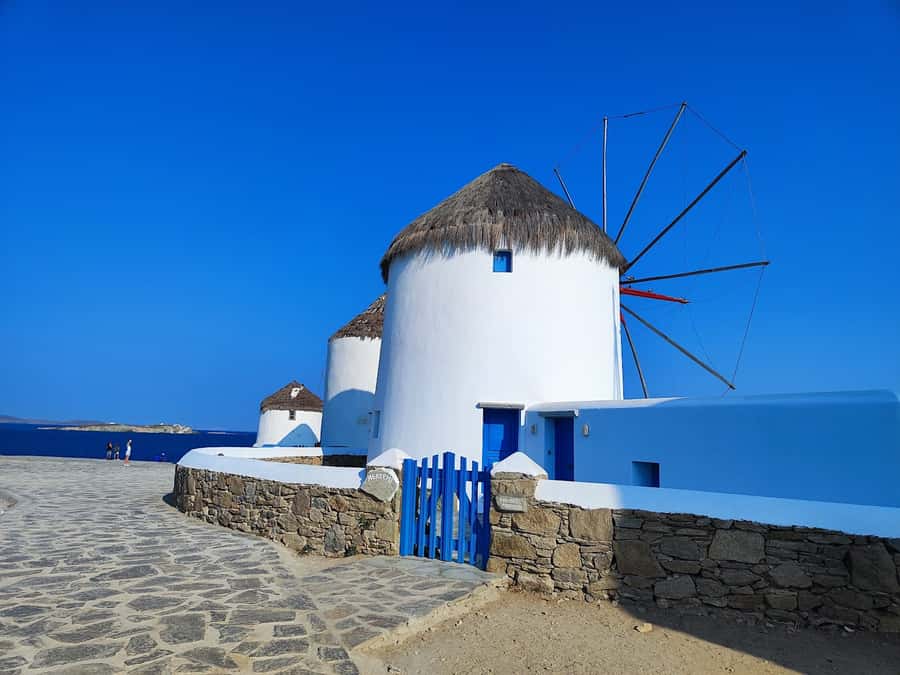
The old windmills of Mykonos are not decoration. Islanders built them to use a wind they could count on.
How strong does it get?
Most meltemi days are a fresh to strong breeze — enough to make a beach umbrella a hazard and a small boat uncomfortable. On the stronger days it reaches gale force. Greek port authorities issue sailing bans when winds reach around Beaufort 8, and high-speed craft are stopped earlier than large conventional ferries, which are heavier and handle rough seas better. Bans are not rare events: one hit sailings as recently as 31 July 2026.
A meltemi spell can last one day or run for a week. Forecasters can usually see it coming a few days ahead, which is why checking the forecast before a crossing is worth more than any general rule.
What it means for ferries
If you are island-hopping in July or August, the meltemi is the single biggest risk to your schedule.
- High-speed boats are the first to go. Catamarans and fast ferries are cancelled or delayed at lower wind speeds than large ships. If a crossing matters, a conventional ferry is the safer choice, even if it is slower.
- Expect a rough ride even when you sail. Sit low and in the middle of the ship, keep your eyes on the horizon and take seasickness tablets before departure, not after.
- Build in buffer days. Plan at least one spare day before any flight home, and ideally end your trip on an island with an airport or a short crossing to Athens.
- Stay in touch with the operator. Changes are announced by the ferry company and at the port. Keep your phone number and email on the booking.
Our ferry booking guide covers tickets, check-in and what happens when a sailing is cancelled, and the ferries hub lists the operators and ports.
Where to find shelter
A north wind has a simple consequence: south-facing coasts are sheltered, north-facing coasts take the hit.
- Mykonos: the south coast beaches, such as Psarou, are the calm side. North-coast bays such as Ftelia are the windsurfers' domain.
- Naxos: the long west-coast beaches are exposed to varying degrees; on windy days, look for spots tucked behind headlands. Mikri Vigla is known for kitesurfing precisely because it catches the wind.
- Paros: the east coast around Golden Beach is a long-standing windsurfing spot; smaller coves near Naoussa can be calmer.
- Milos: boat trips to Kleftiko on the south-west coast depend on the wind, and the island's beaches are often chosen on the day according to its direction — see our Milos guide.
Local advice beats any map. Ask where the wind is blowing from that day and where the islanders are swimming.
Where the meltemi barely reaches
If wind is a deal-breaker, choose a different part of Greece for July and August.
- The Ionian islands — Corfu, Paxos, Kefalonia, Zakynthos and Lefkada — sit on the other side of the mainland. They get a lighter afternoon sea breeze from the north-west, the maistro, which is pleasant rather than disruptive. Lefkada's Vasiliki Bay is famous among windsurfers because that breeze funnels into it reliably in the afternoon.
- The Saronic islands near Athens are relatively sheltered.
- Crete's south coast is protected from the north by the island's mountains, although gusts can come down through the gorges.
- Halkidiki and the northern mainland coast are generally calmer.
Is it a reason to avoid the Cyclades?
No — but it is a reason to plan them properly. The meltemi keeps the Cyclades cooler, clears the air and gives them their sharp summer light. For most visitors, it means a few afternoons at a sheltered beach instead of the one they had in mind, and perhaps a rough crossing.
Where it genuinely matters:
- Tight itineraries. Three islands in six days with a flight on day seven is fragile in August. Two islands with a buffer day is not. Our Cyclades island-hopping guide suggests routes that allow for it.
- Small islands with few connections. When a ferry is cancelled on a route with one sailing a day, the next option may be tomorrow or later.
- Families with young children or anyone prone to seasickness. June and September usually mean calmer crossings than July and August.
- Boat trips. Excursions to sea caves and exposed coves are the first to be called off.
For windsurfers and kitesurfers, it is the point
The same wind that frustrates ferry passengers draws sailors, windsurfers and kitesurfers from across Europe. The reliable summer breeze on the Cyclades, especially around Paros and Naxos, supports a well-established scene of schools and rental centres, and conditions suit intermediate and advanced riders on the stronger days. Beginners usually learn in the calmer morning hours or on a sheltered bay.
The practical checklist
- Check a marine forecast in Beaufort for the day of every crossing.
- Book conventional ferries for the legs that cannot slip.
- Keep at least one buffer day before your flight home.
- Choose accommodation with a sheltered terrace if you want long outdoor dinners.
- Pick south-facing beaches on windy days, and ask locals.
- Take seasickness tablets early.
For monthly conditions, see our August weather page and the full month-by-month guide.
Prices, fees and rules in this piece were checked in September 2026. They change — confirm with the operator or site before you travel.
Where to stay nearby
Live prices and availability on a map centred on this exact spot — hotels, studios and villas — so you can judge the distance to the beach, the port or the village from here rather than guess from an address.
Bookings made through this map earn us a commission. Your price is unaffected.
A travel advisor who writes about Greece the way he advises on it: island by island, with the catch attached to every recommendation. More about the author →
Frequently asked
When does the meltemi blow in Greece?
Typically from mid-May to mid-September, peaking in July and August. It is usually calmer in the morning and strongest in the afternoon, and a spell can last from one day to a week.
Which islands are most affected by the meltemi?
The Cyclades, including Mykonos, Naxos, Paros, Ios and Tinos, along with the open Aegean. The Ionian islands, the Saronic islands and Crete's south coast are much less affected.
Does the meltemi cancel ferries?
Sometimes. Port authorities ban sailings when winds reach around Beaufort 8, and high-speed boats are stopped earlier than large conventional ferries. Keep a buffer day before your flight home.
Which beaches are sheltered from the meltemi?
Because the wind comes from the north, south-facing beaches are usually the calm ones — for example the south coast of Mykonos. North-facing beaches catch the wind and suit windsurfers.
Is the meltemi dangerous for swimming?
On strong days, exposed beaches get big waves and currents, and inflatables can be blown out to sea. Swim on sheltered beaches, respect lifeguard flags where present and never use inflatables in offshore wind.
Before you go
We may earn a commission from these. It never changes your price.
Blog