GuidesFood & drink
Thessaloniki Food Guide: Bougatsa, Meze, Markets and How the City Eats
Greece's food capital, eaten the local way: bougatsa at breakfast, koulouri on the go, long meze evenings with tsipouro, and the old central markets.
Contents · 9
The short version
- Thessaloniki is the city Greeks travel to for food. It eats earlier, longer and more cheaply than Athens, and its cooking carries the flavours of Asia Minor, Pontus, the Balkans and the city's old Sephardic community.
- Breakfast is bougatsa, a warm filo pie with custard cream or cheese. On the move, it is a sesame koulouri.
- Evenings are meze: many small plates, shared, with tsipouro or ouzo, stretched over hours.
- The central markets are where the city shops, not a show put on for visitors. Go in the morning.
- Getting in is easy: airport buses 01X and 01N cost €2, and the city now has a metro, open since November 2024.
This guide does not send you to specific restaurants. Places change hands and quality drifts; the dishes and the habits do not. Learn those, and you will eat well almost anywhere in the centre.
Why Thessaloniki eats differently
Thessaloniki has always been a port and a crossroads. For centuries it was one of the great cities of the Ottoman Empire, with a large Sephardic Jewish population, and after 1922 it absorbed tens of thousands of Greek refugees from Asia Minor and the Black Sea coast. Each of those communities brought recipes, spices and a way of sitting at the table.
The result is a city whose everyday food is more spiced and more generous than the Greek average. Sweet and savoury pies, cumin-scented meatballs, peppers from the surrounding plains, mussels from the Thermaic Gulf and a strong pastry culture all come from this layered history. It is also a university city, which keeps prices honest and the evenings long.
Breakfast: bougatsa and koulouri
Bougatsa
If you eat one thing in Thessaloniki, make it bougatsa. It is a pie of many thin filo layers, baked and cut into squares while still warm. The sweet version holds a semolina custard cream and is finished with icing sugar and cinnamon; the savoury versions are filled with cheese or with minced meat, and some places also do spinach.
A few tips:
- Eat it early. Bougatsa is a morning food, at its best fresh from the tray. Many specialist shops open early and sell out of the best batches by late morning.
- Order by weight or by portion, and ask for it cut. Locals often mix half sweet, half cheese.
- Drink it with coffee. A freddo espresso in summer, a Greek coffee in winter — see our piece on Greek coffee culture.
Koulouri
The koulouri Thessalonikis is a thin ring of bread crusted with sesame, sold from bakeries and street carts across the centre from early morning. It is the city's walking breakfast: cheap, filling and eaten on the way to somewhere. Plain is classic; you will also find versions with cheese or chocolate.
Something sweet
Thessaloniki takes pastry seriously. Look for trigona, crisp filo triangles filled with cream and soaked in syrup, a speciality of the Panorama district above the city, and for tsoureki, the soft braided sweet bread flavoured with mahlab and mastic. Syrupy Asia Minor desserts such as kataifi and baklava turn up in almost every pastry shop.
The markets
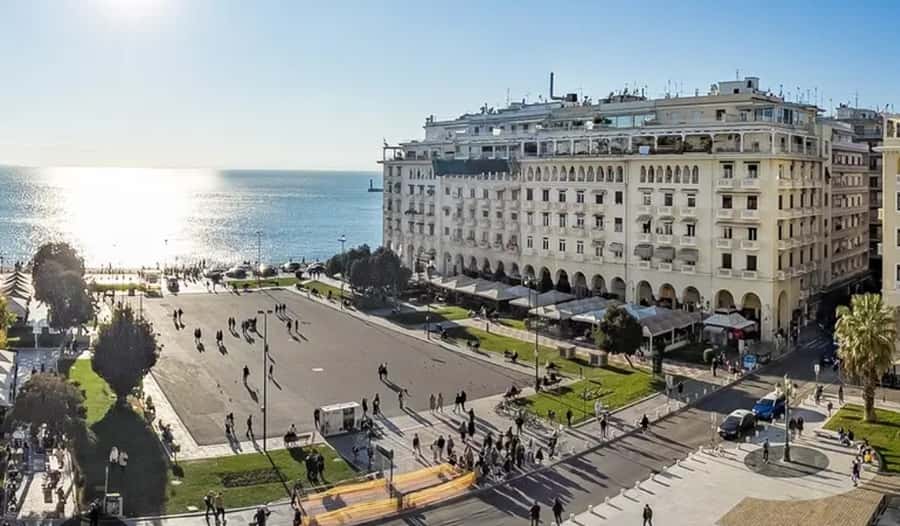
The historic markets lie in the grid of streets between Aristotelous Square and Venizelou, a few minutes' walk from the waterfront.
Kapani, also called Vlali, is the older and noisier of the two: narrow covered lanes of fishmongers, butchers, spice and olive sellers, cheese counters and fruit stalls, with small eateries tucked in between. Modiano, a covered market hall built in the early twentieth century, has been renovated and mixes traditional stalls with places to eat and drink.
How to do them well:
- Go in the morning, when trade is busiest and the fish is on ice. By mid-afternoon many stalls are closing.
- Buy things that travel: dried oregano and mountain tea, spices, good olives, sesame halva, loukoumi, pastourma if you can keep it cool.
- Watch, then point. Stallholders are used to visitors; smile, ask to taste and do not haggle on staples.
Meze culture: how an evening works
The heart of eating in Thessaloniki is the meze meal: no starters and mains, just a steady flow of small plates in the middle of the table, ordered in rounds and shared by everyone. The old warehouse quarter of Ladadika, near the port, is the best-known district for it, though locals will tell you that some of the best meze is found in ordinary neighbourhood places away from the centre.
What typically arrives:
- Spreads and dips — tzatziki, a spicy whipped cheese called tirokafteri, aubergine salad
- Peppers — grilled florina peppers, roasted or stuffed; the region grows superb ones
- Mussels from the Thermaic Gulf, steamed, fried or cooked saganaki with tomato and feta
- Small fish — fried anchovies or sardines, grilled octopus
- Meat — soutzoukakia, oval meatballs in tomato sauce with cumin, an Asia Minor dish, plus grilled sausages and kebabs
- Cheese — fried saganaki, feta with oregano and oil
The rhythm. Order a few plates, then more. Nobody expects you to decide everything at once, and nobody will rush you. A meze evening can easily last three hours.
The drinks. In the north, tsipouro is the usual partner: a grape-pomace spirit, served in small carafes, with or without anise. Ouzo is equally at home. Both are drunk slowly with water or ice alongside food, never shot. In some traditional places a small plate comes out with each round of drinks, but do not assume it; it varies from place to place. If you prefer wine, northern Greece produces serious reds from xinomavro — our guide to Greek wine regions explains where it comes from.
For a general primer on ordering, see what to order in a Greek taverna.
Eating between the sights
Thessaloniki is compact enough to plan a day around meals. A good loop:
- Morning: bougatsa and coffee, then the markets near Aristotelous Square.
- Late morning: walk the waterfront to the White Tower.
- Lunch: something light — a koulouri, a souvlaki wrap, or a few market plates.
- Afternoon: the Roman quarter around the Rotunda and the Arch of Galerius, or the Museum of Byzantine Culture in the heat of the day.
- Sunset: climb to the Upper Town and the walls of the Heptapyrgion for the view over the gulf.
- Dinner: walk back down for meze. Locals rarely sit down before 21:00 in summer.
When to go
Food is good all year, but the city is at its most appealing in spring and autumn. November brings the Thessaloniki International Film Festival, which in 2026 runs from 5 to 15 November, filling the waterfront and the cafés with a very different crowd. Midsummer is hot and humid, and many locals leave for the beaches of Halkidiki at weekends.
Getting there and getting around
By air. Thessaloniki airport (SKG) is south-east of the centre. City buses 01X by day and 01N at night run to the centre for €2, prices checked September 2026. Taxis wait outside too; by law they must accept cards and give you a receipt. More on the airports page.
In town. The centre is walkable. The metro, open since November 2024, runs under the main east–west axis and is useful for longer hops; buses cover the rest. See getting around Greece.
From Romania. Thessaloniki is the most natural first stop for Romanians driving south through Bulgaria and the Kulata–Promachonas border. Our from Romania page covers routes, vignettes and tolls, and the Egnatia Odos tolls guide helps if you are continuing east towards Kavala.
Start with the Thessaloniki destination page for sights, beaches and places to stay.
A few honest rules
- Skip the waterfront tourist menus with photos of every dish. Walk two streets inland.
- Ask what is fresh today, especially for fish, which is usually priced by weight.
- Eat late, eat slowly, share everything. That is not etiquette; it is simply how the city works.
Prices, fees and rules in this piece were checked in September 2026. They change — confirm with the operator or site before you travel.
Where to stay nearby
Live prices and availability on a map centred on this exact spot — hotels, studios and villas — so you can judge the distance to the beach, the port or the village from here rather than guess from an address.
Bookings made through this map earn us a commission. Your price is unaffected.
A travel advisor who writes about Greece the way he advises on it: island by island, with the catch attached to every recommendation. More about the author →
Frequently asked
What is bougatsa and when do you eat it?
A pie of thin filo layers filled with semolina custard (sweet, with icing sugar and cinnamon) or with cheese or minced meat. It is a breakfast food in Thessaloniki, best eaten warm in the morning with coffee.
What is the difference between tsipouro and ouzo?
Ouzo is a clear spirit always flavoured with anise. Tsipouro is distilled from grape pomace and can be made with or without anise; it is the usual meze drink in northern Greece. Both are sipped slowly with water or ice alongside food.
Where are the food markets in Thessaloniki?
Kapani (Vlali) and Modiano are in the streets between Aristotelous Square and Venizelou, close to the waterfront. Go in the morning, when the stalls are busiest.
How do I get from Thessaloniki airport to the centre?
City buses 01X by day and 01N at night run to the centre for €2, checked September 2026. Taxis are available outside and must accept cards.
When is the Thessaloniki International Film Festival in 2026?
The 67th edition runs from 5 to 15 November 2026.
Partner links · GetYourGuide
Tours, boat trips & tickets
Boat trips, guided tours of the ancient sites and tickets bookable ahead — free cancellation on most.
- Thessaloniki food tourGreece's food city: bougatsa for breakfast, the Kapani and Modiano markets, meze with tsipouro.See food tours →
- Vergina royal tombsThe Macedonian royal tombs attributed to Philip II, in an underground museum.See day trips →
We may earn a commission from these. It never changes your price.
Before you go
We may earn a commission from these. It never changes your price.
Guides