GuidesRoad trips
Driving to Greece from Romania: The Whole Route, Step by Step
Bucharest or Timisoara, Makaza or Kulata, and where each route actually leaves you: Halkidiki, the Olympic Riviera, Thassos or Samothraki.
Contents · 6
The short version
There is no single road to Greece. There are two, they split in Bulgaria, and the one you want is decided by where you are going, not by which looks shorter on the map.
- Kulata–Promachonas, through Sofia, for Thessaloniki, Halkidiki and the Olympic Riviera.
- Makaza–Nymfaia, through Kardzhali, for Kavala, Keramoti and the ferry to Thassos, and for Alexandroupoli and Samothraki.
Everything else — the Danube bridge, the vignettes, where you sleep — follows from that choice. Prices in this guide were checked September 2026.
Leaving Romania: which bridge
From Bucharest, Ploiesti, Constanta or anywhere east, you cross at Giurgiu–Ruse. A car pays 15 lei leaving Romania, and since June 2026 you can pay online in advance and use the dedicated lanes, which on a July Saturday is the difference between five minutes and an hour.
From Timisoara, Arad, Oradea, Cluj or Craiova, you cross at Calafat–Vidin instead: €6 each way for a car. From the west this is not a detour, it is the natural line towards Sofia, and it avoids driving the length of the country to Giurgiu first.
Both bridges put you on the Bulgarian network, where you need an e-vignette registered to your number plate before you drive onto a toll road. The rates and the traps are in our piece on the Bulgarian vignette in 2026; the short version is that a monthly vignette costs €19.90 and two weeklies cost €20.00, so buy the month.
Route one: Kulata–Promachonas, through Sofia
This is the route most Romanian families drive, because it ends at the beaches most Romanian families book.
From Ruse you run south-west through Pleven or Veliko Tarnovo towards Sofia, then join the E79 south towards Blagoevgrad and the border at Kulata. Ruse to Kulata is roughly 507 km and about six hours fifty at the wheel. Bucharest to Thessaloniki is typically nine to ten hours of driving, before any queue.
Two things will slow you more than the border. The first is the Kresna Gorge on the E79: the motorway bypass is still being built and is not due before the end of 2027, so you drop onto a two-lane road squeezed between the river and the rock, behind trucks, for a stretch that feels much longer than it is. The second is the summer traffic of everyone else doing the same thing on the same Saturday.
Once through Promachonas you are on Greek motorway. Thessaloniki appears in about an hour and a half, and from there:
- Halkidiki — around 50 minutes to Sani on Kassandra, an hour and a quarter to an hour and forty to Neos Marmaras on Sithonia, about two hours to Ouranoupoli, longer in August traffic. Which finger suits you is the whole argument of our Halkidiki comparison, and the beaches are the reason to care.
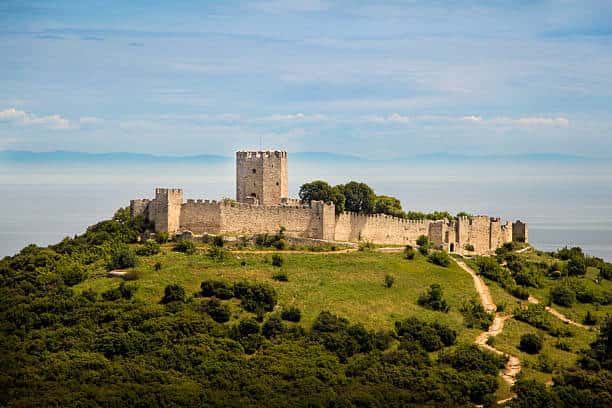
- Olympic Riviera — Paralia Katerinis is roughly 70 km south of Thessaloniki, about an hour, on the motorway that runs under Mount Olympus, with Litochoro and the mountain trailheads just inland. You will pass Platamon castle on its hill above the road; it is the moment the drive stops feeling like a transfer.
- Further south or west — Athens is another five hours or so; Meteora is a sensible inland break; Parga and Lefkada mean crossing the country westwards on the Egnatia Odos, which is a day in itself.
Route two: Makaza–Nymfaia, through Kardzhali
The eastern route is shorter, emptier and more beautiful, and it is the one that ends at a ferry.
From Ruse you go south through Veliko Tarnovo, Haskovo and Kardzhali to the Makaza pass — roughly 365 km and about five hours fifteen. The pass takes cars but not trucks over 3.5 tonnes, which is exactly why it is pleasant, and the mountain section is slow, winding and badly lit. Drive it in daylight. Bucharest to Keramoti is about 560 km, some seven to eight hours, plus the crossing.
What it opens:
- Thassos. From Keramoti, the ANETH ferry reaches Limenas in about 35–40 minutes: €6 an adult, €3 a child, €22 for a car up to 4.25 m and €27 for a longer one. There is a second line from Kavala to Prinos. Tickets are sold at the port. The island has its own sister site — thassos.online — with the beaches, villages and tavernas.
- Samothraki. Carry on east to Alexandroupoli and take the boat to Kamariotissa, roughly two hours with your car. It is a mountain in the sea rather than a beach island: cold river pools at Gria Vathra, the Sanctuary of the Great Gods where the Winged Victory was found, goats everywhere.
- Limnos and the north Aegean line, from Kavala. How these crossings work with a car is the subject of our guide to the northern car ferries.
What to settle before you leave
- Vignettes. Romanian rovinietă for the roads south, Bulgarian e-vignette bought online before the border. Neither is expensive; both are automatically enforced by camera.
- Documents. Romania has been fully in Schengen since January 2025, so you travel on an identity card and there are no systematic land checks — but carry licence, registration and valid insurance. The detail is in the border, in practice.
- Fuel. In September 2026 petrol cost around €1.60 a litre in Bulgaria against roughly €2.00–2.10 in Greece. Fill up before Promachonas or Nymfaia, and again on the way home. What the whole drive adds up to is worked through in fuel and the real cost of the drive.
- Timing. Leaving at four in the morning buys you the empty half of Bulgaria. Mid-August is the worst week of the year on this road in both directions, and 15 August is the single worst day.
- Sleep. If the drive is longer than your family can take in one sitting, decide where to break it before you set off rather than at midnight in a petrol station: where to sleep on the way names the honest stopping points.
Driving in Greece once you are there
Greek motorway tolls are charged at booths, and the Egnatia Odos has been priced by distance since January 2026 at €0.04 per km plus VAT — Thessaloniki to Kavala works out at about €6.95, and the full run from Igoumenitsa to Kipoi at €30.45. The arithmetic is in Egnatia Odos tolls in 2026.
The traffic code tightened in September 2025 and the fines are serious: €350 and a one-month licence suspension for holding a phone at the wheel, €350 and thirty days for 0.50–0.80 g/l of alcohol. The general limit is 0.5 g/l and 0.2 for new drivers. Speed limits are typically 50 in towns, 90 on open roads and 110–130 on expressways and motorways, but follow the signs, which change often.
Parking is the real daily friction. In Paralia, Nikiti or Ouranoupoli in August you will circle; in Thessaloniki use a garage and walk. Getting around Greece covers island driving, and our prices page keeps every figure on this site with the date it was checked.
Still deciding where this road should end? The island finder sorts places by the holiday you actually want, and Greece from Romania is the hub for everything above.
Prices, fees and rules in this piece were checked in September 2026. They change — confirm with the operator or site before you travel.
Where to stay nearby
Live prices and availability on a map centred on this exact spot — hotels, studios and villas — so you can judge the distance to the beach, the port or the village from here rather than guess from an address.
Bookings made through this map earn us a commission. Your price is unaffected.
A travel advisor who writes about Greece the way he advises on it: island by island, with the catch attached to every recommendation. More about the author →
Frequently asked
How long does it take to drive from Bucharest to Greece?
To Thessaloniki, typically nine to ten hours at the wheel via Sofia and Kulata, before queues and breaks. To Keramoti and the Thassos ferry, about 560 km and seven to eight hours via Makaza. Add a couple of hours for a summer Saturday.
Makaza or Kulata — which crossing is better?
They serve different halves of northern Greece. Kulata, through Sofia, is the route for Thessaloniki, Halkidiki and the Olympic Riviera. Makaza, through Kardzhali, is shorter and quieter and takes you to Kavala, Keramoti, Thassos and Alexandroupoli. Makaza is closed to trucks over 3.5 tonnes, which is part of its charm.
Do I still stop at the borders now that Romania is in Schengen?
There are no systematic land checks between Romania, Bulgaria and Greece since January 2025, and Romanians travel on an identity card. Police can still stop you, so carry licence, registration and insurance.
What do the road charges cost for the drive?
A 30-day Romanian rovinieta is €9.50 and a monthly Bulgarian vignette €19.90; the Giurgiu bridge is 15 lei leaving Romania and Vidin–Calafat €6 each way; Greek motorway tolls are modest, with Thessaloniki to Kavala about €6.95 on the Egnatia. Prices checked September 2026.
Should I break the journey overnight?
If you have one driver, small children, or you leave after work, yes — and decide where in advance. Two drivers who leave before dawn usually do it in a day. Our guide to sleeping on the way sets out the honest stopping points.
Before you go
We may earn a commission from these. It never changes your price.
Guides