GuidesIslands
Santorini vs Mykonos: An Honest Comparison Before You Book
Caldera views and cruise crowds, or beach clubs and the meltemi? How Santorini and Mykonos really compare on views, beaches, cost, wind and access.
Contents · 10
- ΑThe short version
- ΒThe view: Santorini wins, and it is not close
- ΓThe beaches: Mykonos wins clearly
- ΔCrowds and cruise ships
- ΕWind: the meltemi matters more on Mykonos
- ΣΤCulture and day trips
- ΖCost: both are expensive, in different ways
- ΗGetting there and between them
- ΘWho should pick which
- ΙCan you do both?
The short version
Pick Santorini if the trip is about a view: the caldera, a terrace, a sunset you will remember in twenty years. Pick Mykonos if the trip is about days on the beach and nights out, with a pretty town as the backdrop. Both are expensive, both are busy in July and August, and both are Cycladic islands linked to Athens by air and sea. Beyond that, they are almost opposites — and a surprising number of people would be happier on neither. We will get to that too.
- Best for — Santorini: views, couples, wine, sunsets. Mykonos: beaches, beach clubs, nightlife.
- Beaches — Santorini: dark volcanic sand and pebbles. Mykonos: golden sand, many organised.
- Main crowd issue — Santorini: cruise passengers in Fira and Oia. Mykonos: cruise passengers plus peak-summer party crowds.
- Wind — Santorini: exposed, but the drama does not depend on calm seas. Mykonos: very exposed to the meltemi.
- Airport — Santorini: JTR. Mykonos: JMK, closed on Thursdays from 19 November 2026 to 18 March 2027.
The view: Santorini wins, and it is not close
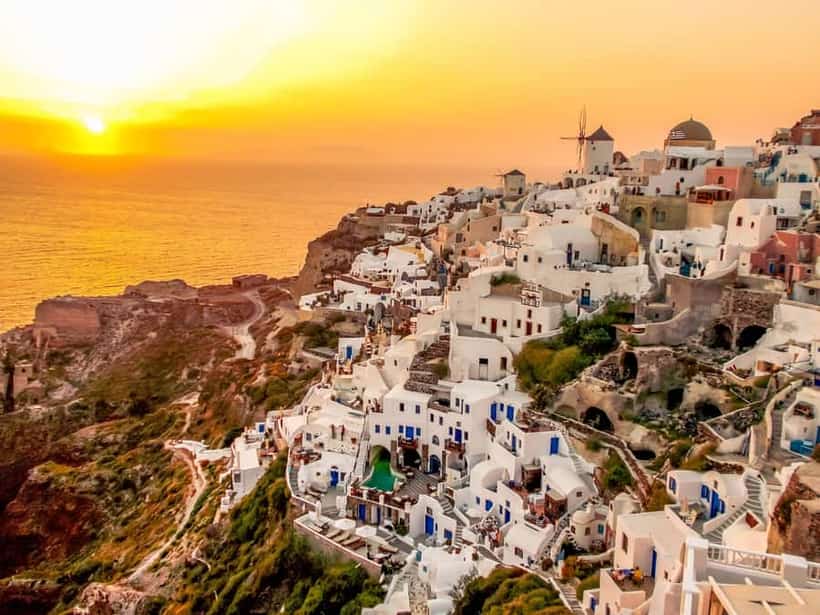
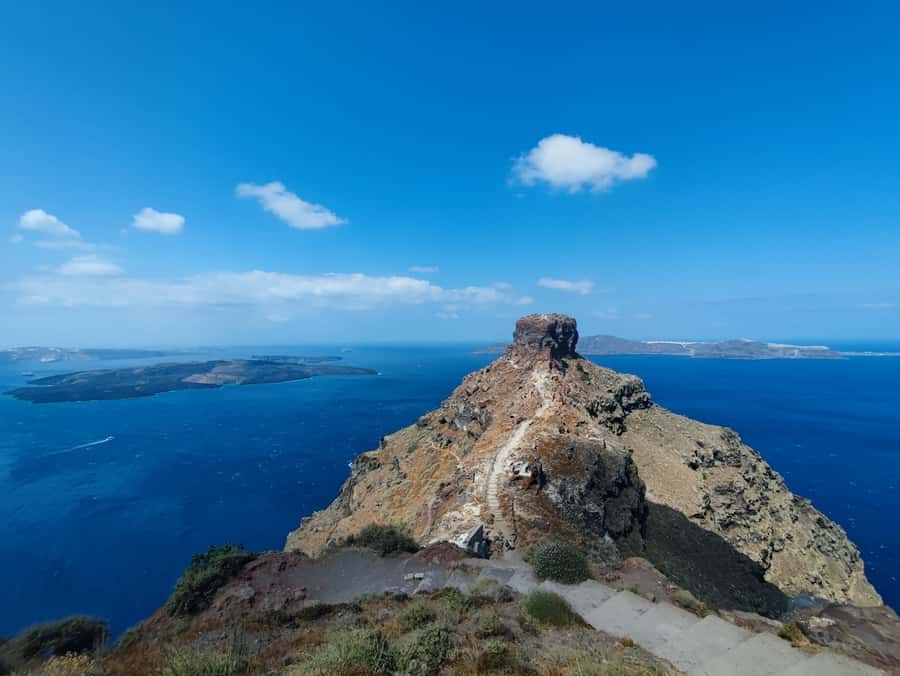
Santorini is the rim of a flooded volcano. The towns of Fira, Imerovigli and Oia sit along a cliff edge that drops to the water, and the sight of that ring of whitewashed houses above a blue crater is the reason the island is famous. The walk along the caldera from Fira towards Oia is one of the best things you can do on any Greek island; start early, carry water, and detour to Skaros Rock, the old fortress headland below Imerovigli.
Mykonos is lovely in a different register. Chora is a maze of white lanes and blue shutters; Little Venice has houses built right over the water, and the row of windmills above it is the island's postcard. It is a beautiful town, but it is not a landscape that stops you in your tracks the way the caldera does.
The beaches: Mykonos wins clearly
This is the part that disappoints people who choose Santorini for a beach holiday. Its beaches are made of dark volcanic sand and pebbles, and they get very hot underfoot in summer. They are interesting rather than idyllic, and most sit on the south and east coasts, far from the caldera villages where the views are.
Mykonos has the classic Aegean beach: golden sand, clear water and, on the south coast, a string of organised beaches with sunbeds, restaurants and clubs. Psarou is the polished, see-and-be-seen version; there are wilder coves if you have a car and a tolerance for dirt tracks. Note that Greek law protects free public access to the shoreline, so even on organised beaches you are entitled to lay your towel along the water's edge.
Crowds and cruise ships
Both islands are cruise destinations, and on ship days you feel it. Santorini now limits arrivals to 8,000 cruise passengers a day, and since July 2025 both Santorini and Mykonos charge a per-passenger cruise fee: €20 from June to September, €12 in April, May and October, and €4 from November to March. The cap takes the edge off the worst days on Santorini, but Oia at sunset and the lanes of Fira in late morning are still crowded. Our piece on Santorini's cruise fee and daily cap explains the rules.
Mykonos handled around 1.29 million cruise passengers in 2024, and the old town fills when several ships are in. The practical fix is the same on both islands: explore the famous spots early in the morning or in the evening after the ships have sailed, and spend the middle of the day on a beach, a boat or a winery terrace.
Wind: the meltemi matters more on Mykonos
The meltemi is the strong north wind of the Aegean summer, typically blowing from mid-May to mid-September and strongest in July and August, often in the afternoon. Mykonos is famously windy; on a meltemi day north-facing beaches are sandblasted and small boats stay in port. The south-coast beaches are the sheltered ones, which is partly why they are so developed. Santorini feels the wind too, but its caldera villages face west, and the drama of the place does not depend on a calm sea. Read our meltemi explainer before you plan boat trips on either island.
Culture and day trips
Santorini has more depth than its honeymoon image suggests. Akrotiri, the Bronze Age town buried by the eruption, is one of the most remarkable prehistoric sites in the Aegean, and a boat trip to the volcano in the middle of the caldera is a classic half-day. The island's vineyards, growing Assyrtiko in volcanic soil, give you a reason to head inland.
Mykonos has one trump card: Delos, the sacred island of Apollo, a short boat ride away. It is one of the great archaeological sites of Greece. Entry is €20 (reduced €10), the boat is not included, and the Delos Tours boat from Mykonos costs €25 return for adults, with a morning departure at 10:00 and an afternoon sailing at 16:30 in the main season. There is no swimming and no overnight stay on the island, so go early and bring a hat.
Cost: both are expensive, in different ways
Neither island is a budget destination, and neither benefits from the reduced VAT rate that applies on some smaller Dodecanese and North Aegean islands. On Santorini the premium is for the view: a caldera-facing room costs far more than the same room a few hundred metres inland or on the east coast. On Mykonos the premium is for the scene: beach-club sunbeds, cocktails and restaurant bills in Chora add up quickly.
Two small fixed costs to know. Greece charges a climate resilience fee per room per night, paid at checkout: from April to October it is €10 at a 4-star hotel and €15 at a 5-star. And on Santorini, the cable car between Fira and the old port costs €10 one way, while the local KTEL bus from Fira to Oia, the airport or Kamari is €2.20, and to Perissa or the Athinios ferry port €2.70. Prices checked September 2026.
Getting there and between them
Both islands have international airports with direct summer flights from much of Europe, plus year-round flights from Athens. Mykonos airport will close to traffic every Thursday from 19 November 2026 to 18 March 2027, which matters only if you are travelling in winter.
By sea, Santorini is the further of the two from Athens: the ferry from Piraeus takes roughly 5 hours on a fast boat and 11 hours or more on a slow one, with adult fares from around €46. Mykonos is closer, roughly 2h40 to 5h50 from Piraeus or Rafina, from around €43. Our guide on how to get to Santorini covers the airport and the Athinios port in detail, and the ferries hub lists operators and routes. Direct boats also link the two islands in summer; check the current operator timetable rather than relying on last year's.
Who should pick which
Choose Santorini if you are a couple on a short trip, you care about sunsets and scenery more than sand, you like wine, or you want a place that feels extraordinary even if you never swim. Book a caldera room, stay two to four nights and do the Fira–Oia walk.
Choose Mykonos if you want long beach days with good facilities, you enjoy beach clubs and late dinners, and you do not mind the wind or the bill. Base on the south coast for the beaches or in Chora for the evenings, and give one morning to Delos.
Choose neither if you want value, calm or authenticity in the everyday sense. Naxos, Paros, Milos or Sifnos will give you better beaches than Santorini and a gentler pace than Mykonos, and all of them can be combined with a short Santorini stay. Our guide to the best Greek islands for 2026 matches islands to travel styles.
Can you do both?
Yes, and plenty of people do: three nights on Mykonos, three on Santorini, with a fast ferry in between and an extra night in Athens before the flight home. It is a spectacular week, though an expensive and busy one. If you do it, put Santorini last so the trip ends on the view — and keep a buffer day, because in high summer the meltemi can cancel the smaller high-speed boats.
Prices, fees and rules in this piece were checked in September 2026. They change — confirm with the operator or site before you travel.
Where to stay nearby
Live prices and availability on a map centred on this exact spot — hotels, studios and villas — so you can judge the distance to the beach, the port or the village from here rather than guess from an address.
Bookings made through this map earn us a commission. Your price is unaffected.
A travel advisor who writes about Greece the way he advises on it: island by island, with the catch attached to every recommendation. More about the author →
Frequently asked
Which is better for beaches, Santorini or Mykonos?
Mykonos. It has golden-sand beaches, many of them organised, especially on the sheltered south coast. Santorini's beaches are dark volcanic sand and pebbles that get very hot in summer.
Which island is better for a honeymoon?
Santorini, if the priority is a caldera view and sunsets. Couples who want beaches and a livelier evening scene usually prefer Mykonos, and those who want calm and value often choose Milos or Naxos instead.
How crowded is Santorini with cruise ships?
Busy on ship days, especially in Fira and at Oia around sunset. Santorini caps cruise arrivals at 8,000 passengers a day. Visit the famous spots early in the morning or in the evening after the ships leave.
How do I get from Athens to Santorini or Mykonos?
Both have airports with flights from Athens. By ferry from Piraeus, Santorini takes roughly 5 to 11+ hours depending on the boat, and Mykonos roughly 2h40 to 5h50 from Piraeus or Rafina. Check the operator for current timetables.
Is the Mykonos airport open in winter?
Mostly, but the runway is closed every Thursday from 19 November 2026 to 18 March 2027. Plan winter flights for other days, or reach the island by ferry from Piraeus or Rafina.
How much does a trip to Delos from Mykonos cost?
The Delos Tours boat costs €25 return for adults, and site entry is €20 (reduced €10), prices checked September 2026. There is no swimming on Delos, so go early and bring water and a hat.
Partner links · GetYourGuide
Tours, boat trips & tickets
Boat trips, guided tours of the ancient sites and tickets bookable ahead — free cancellation on most.
- Volcano & hot springsWalk the crater on Nea Kameni, then swim to the warm, rust-coloured springs off Palea Kameni. Wear shoes you do not mind ruining.See guided tours →
- Akrotiri, the Bronze Age townA prehistoric town preserved under volcanic ash, under a roof — one of the few sights on the island that works in the midday heat.Check tickets →
- Oia at sunset, organisedThe most crowded half-hour on the island. A tour handles the ride back, which is the hard part.See guided tours →
- Caldera sunset catamaranUnder the caldera cliffs to the volcanic islets and swim stops, with the sunset seen from the water rather than from a packed wall in Oia.See boat trips →
We may earn a commission from these. It never changes your price.
Before you go
We may earn a commission from these. It never changes your price.
Guides