GuidesIslands
Kos vs Rhodes: The Two Dodecanese Package Islands
Flat, cheap and easy, or walled, historic and bigger? What really separates Kos from Rhodes — including a VAT rate that only one of them gets.
Contents · 8
The short version
Both are long, sunny Dodecanese islands with a big airport, a crusader castle, a strip of package resorts and a very long season. The difference is weight.
- Rhodes has one of the great walled cities of Europe, a UNESCO site since 1988, plus Lindos, Kamiros and enough history to fill a week on its own. It is bigger, busier, better known and more expensive.
- Kos is flatter, smaller, cheaper and far easier to get around — you can genuinely cycle it — with the Asklepieion, a Turkish coast within a short boat ride and a volcano as a day trip. It has less to see and a lot less friction.
Their faults, plainly. Rhodes's east coast is a near-continuous resort line, its Old Town is a cruise stop that fills and empties by the hour, and the south-east still shows the July 2023 wildfires that forced around 19,000 people out. Kos has thinner sights, a resort belt at Kardamena and Tigaki that could be anywhere in the Mediterranean, and Kos Town took serious earthquake damage in 2017 — some of what you read about it in older guides is no longer standing.
The one concrete money difference
Greece applies a 30% reduced VAT rate on a list of small Dodecanese and north Aegean islands — 17%, 9% and 4% instead of 24%, 13% and 6%. In 2026 that list includes Kos, Symi, Leros, Patmos, Karpathos, Kalymnos, Lesvos, Chios and Samos, and it explicitly does not include Rhodes. It will not change your life, but it shows up on restaurant bills, supermarket shopping and some accommodation across a fortnight.
Everything else being equal, Kos is the cheaper island, and this is part of why. Both still carry the climate resilience fee per room per night: €2 for rooms and apartments, €5 at a 3-star, €10 at a 4-star and €15 at a 5-star from April to October (checked September 2026). The prices page has the rest of the running costs.
Rhodes: the island with a city
Rhodes Town is the argument. The Medieval City has been a UNESCO World Heritage Site since 1988 and is the best-preserved walled town in the eastern Mediterranean; the Street of the Knights runs up to the Palace of the Grand Master, which is a €20 package covering the museum and the Medieval Town sites. About fifty kilometres south, Lindos stacks white houses under an acropolis on a cliff, another €20, with timed slots in use from 2026. Prices checked September 2026, and our Rhodes Old Town and Lindos guide covers how to time both.
The rest of the island supports that. Faliraki and the east coast hold the resorts and the best-known beaches — Tsambika, Anthony Quinn Bay, Saint Paul's Bay under Lindos. The south-west is windier, emptier and ends at Prasonisi, where two seas meet across a sandbar and the kitesurfers gather.
Kos: the island you can cycle
Kos is flat along its north coast, and the island has leaned into it: cycle lanes run out of Kos Town and plenty of visitors get around on two wheels for a week. The town itself is compact, built around the harbour and the Knights' Nerantzia Castle, with Roman and Hellenistic ruins — the ancient agora, the Roman odeon — sitting open between modern streets.
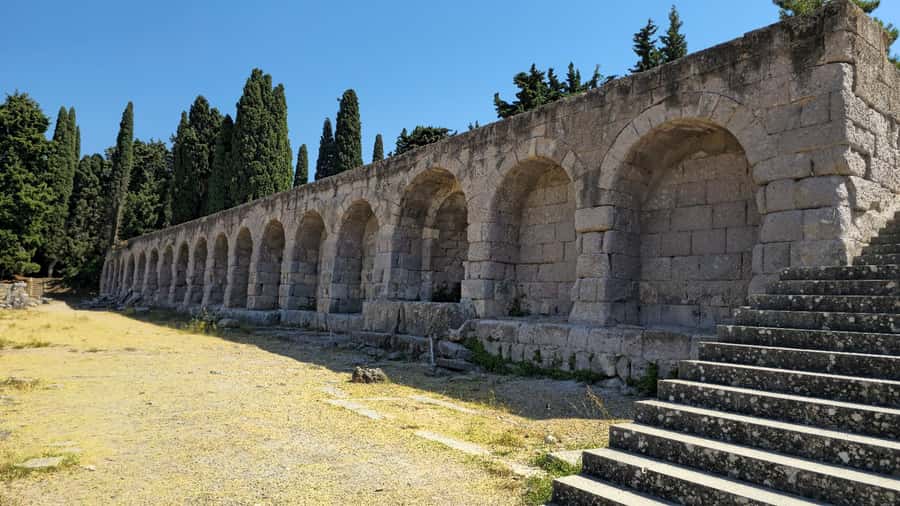
Its best site is the Asklepieion, the terraced healing sanctuary on the hillside above town, associated with Hippocrates, who was born here. Inland, the mountain village of Zia is the sunset stop everyone makes, and Palaio Pyli is the ruined Byzantine one almost nobody does.
The beaches divide the island. Tigaki and Kardamena are the long shallow sandy stretches with the package hotels and, at Kardamena, the nightlife. Kefalos at the south-west end is better: Camel Beach and the coves around it, and Agios Theologos facing the open sea on the far side. The full list is on the Kos beaches page.
Day trips, which is where Kos answers back
Rhodes has one outstanding excursion: Symi, 45 minutes to 1h30 away from around €6, a neoclassical harbour of ochre and white that is worth the early start. Go on the first boat and leave on a late one, because the midday crowd is the whole point of going early.
Kos has two. Boats cross to Bodrum on the Turkish coast, which makes a genuine change of country possible in a day, and the volcano of Nisyros — a caldera you walk into, steaming — is one of the strangest day trips in Greece. Check current operators and, for Turkey, what your passport or ID requires before you book.
Heat, wind and when to go
The Dodecanese keeps its warmth longer than anywhere else in Greece. Rhodes averages highs of 30.4 °C in July and 30.7 °C in August, and still 24.5 °C in October with a sea around 24 °C; Kos sits in the same band. Both are comfortable from May and swimmable deep into October, which is the real reason to choose this corner of the country over the Cyclades.
Wind is the trade-off. Both islands' exposed coasts blow hard in summer — good for kitesurfing at Prasonisi, less good if you wanted a flat sea — so if you are sensitive to it, book on the sheltered side and check our meltemi explainer.
Who should pick which
Choose Rhodes if this is your one trip to the Dodecanese, if you want a town you can spend four evenings in, if history is part of the holiday, or if you are travelling with teenagers who want Faliraki.
Choose Kos if you want a cheaper week, you are travelling with young children or older parents who do not want hills and long transfers, you like the idea of cycling to the beach, or you want Turkey and a volcano on the itinerary.
Choose neither if you want quiet: Symi or Karpathos are the Dodecanese islands without a package trade, and the island finder will point you there. If you are weighing Rhodes against something much bigger instead, read Crete vs Rhodes.
Doing both
They are close neighbours and boats link them, so a week on each is a sensible two-week plan — but check the current Dodecanese timetables rather than assuming a daily sailing, and build in a buffer day. Start on Rhodes while you have the appetite for sites, finish on Kos where the holiday asks less of you. Where to sleep is on the Rhodes stay page and the Kos stay page, and the ferries page lists who sails what.
Prices, fees and rules in this piece were checked in September 2026. They change — confirm with the operator or site before you travel.
Where to stay nearby
Live prices and availability on a map centred on this exact spot — hotels, studios and villas — so you can judge the distance to the beach, the port or the village from here rather than guess from an address.
Bookings made through this map earn us a commission. Your price is unaffected.
A travel advisor who writes about Greece the way he advises on it: island by island, with the catch attached to every recommendation. More about the author →
Frequently asked
Is Kos or Rhodes better for a first visit?
Rhodes, if you only go once. The Medieval City has been a UNESCO site since 1988 and Lindos is among the best sights in the Aegean. Kos wins on price, flat terrain and short transfers, which matters more with small children or limited mobility.
Is Kos really cheaper than Rhodes?
Usually, and part of the reason is structural: Kos is on the list of islands with the 30% reduced VAT rate in 2026, alongside Symi, Leros, Patmos, Karpathos and others, while Rhodes is explicitly excluded.
Can you cycle around Kos?
Along the north coast and out of Kos Town, yes — it is flat and there are cycle lanes, and many visitors use a bike all week. The south-west around Kefalos is hilly, so plan a car or bus for that end of the island.
What are the best day trips from each island?
From Rhodes, Symi: 45 minutes to 1h30 away from around €6, prices checked September 2026. From Kos, boats to Bodrum in Turkey and the volcanic caldera of Nisyros, which you walk into. Check current operators and entry requirements before booking.
How late in the year can you swim?
Deep into October in both. Rhodes averages a high of 24.5 °C in October with a sea around 24 °C, and Kos sits in the same band — the Dodecanese holds its warmth longer than anywhere else in Greece.
Which one has better beaches?
Rhodes for variety and drama — Tsambika, Anthony Quinn Bay, Saint Paul's Bay under Lindos. Kos for ease: long, shallow, sandy stretches at Tigaki, and the better coves down at Kefalos. Neither is a west-coast swimming island; both get windy.
Partner links · GetYourGuide
Tours, boat trips & tickets
Boat trips, guided tours of the ancient sites and tickets bookable ahead — free cancellation on most.
- Rhodes Old Town on footThe walled medieval town of the Knights of St John, UNESCO-listed — much better understood with someone explaining it.See guided tours →
- Lindos by boatDown the east coast by sea to Lindos and its hilltop acropolis, with swim stops — and no parking problem at the other end.See boat trips →
- Symi day tripThe neoclassical harbour of Symi, usually with a stop at the Panormitis monastery.See day trips →
We may earn a commission from these. It never changes your price.
Before you go
We may earn a commission from these. It never changes your price.
Guides